
A minimally invasive, uterus-preserving treatment for heavy bleeding and fibroid pain — no surgery, no hysterectomy.

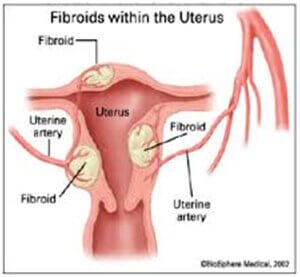
Uterine fibroids are non-cancerous (benign) growths in the uterus. They are very common in women of reproductive age, and while many cause no trouble at all, others produce significant symptoms. Fibroids are classified by where they grow: submucosal (into the cavity of the uterus), intramural (within the muscular wall), and subserosal (on the outer surface).
Fibroids can cause severe symptoms in some women, including heavy menstrual bleeding (the most common reason women seek treatment, and a frequent cause of anaemia), pelvic pain and pressure, swelling or bloating of the abdomen, frequent urination from pressure on the bladder, constipation from pressure on the bowel, pain during intercourse, and fatigue and weakness from anaemia caused by heavy bleeding.
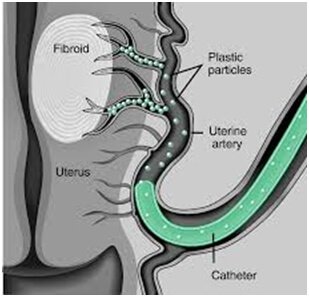
Fibroids stimulate the formation of new blood vessels to supply themselves. During embolization, embolic agents are injected into these fibroid vessels, blocking the abnormal blood supply.
Severe pain or heavy bleeding from uterine fibroids.
You want to avoid surgery, or surgery is too risky for you.
You want to keep your uterus, unlike with a hysterectomy.
UFE is at its best when optimising a future pregnancy is not the chief concern.
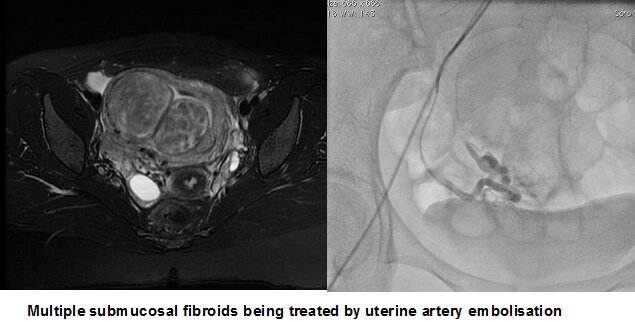
A catheter through the femoral artery injects embolic agents into the uterine arteries.
Most women go home the same day or after one night, lying flat for 4-6 hours first.
Moderate cramping is common for 24 hours, sometimes lasting up to 2 weeks.
Most women return to normal activities within 7 to 10 days.
Only a small puncture in the thigh — not an abdominal incision.
Unlike a hysterectomy, the uterus is kept intact.
Every fibroid is treated in one procedure, regardless of how many there are.
7–10 days to normal activity, versus weeks after surgery — with local rather than general anaesthesia.
Surgery still has an important role — particularly myomectomy for women who want to conceive, and hysterectomy for women who want a definitive, permanent solution. The right choice depends on your symptoms, your fibroids, and your future plans.
UFE is a minimally invasive treatment that shrinks fibroids by blocking their blood supply. A catheter is passed through the femoral artery under local anaesthesia, and particles are injected into the arteries feeding the fibroids. The uterus is preserved.
Yes. There is no surgical incision and no general anaesthesia. UFE is performed under local anaesthesia through a small puncture in the thigh.
You may go home the same day or after one night, lying flat for 4 to 6 hours afterwards. Most women return to normal activities within 7 to 10 days.
Moderate to severe cramping is common in the first 24 hours, managed with pain medicine. Cramps can recur over the following days to 2 weeks — an expected part of the fibroids shrinking.
No. UFE preserves the uterus, which is one of its main advantages over hysterectomy.
Yes. UFE treats all the fibroids in the uterus in a single procedure, however many are present.
UFE is best suited to women whose family is complete. If you are actively planning a pregnancy, discuss all options, including myomectomy, with a gynaecologist and interventional radiologist first.
Yes. Sometimes portions of the treated fibroid tissue pass through the vagina in the weeks after the procedure. This is a recognised part of the fibroids breaking down after their blood supply is blocked.
At Neuro & Vascular, UFE is performed by Dr. Suresh Giragani, Consultant Interventional Radiologist at Apollo Hospitals, Jubilee Hills, Hyderabad, with over 18 years of experience.
Book a consultation with Dr. Giragani, or send your scans and reports for a specialist second opinion.